Beyond AI Performance: Why Reliability Defines the Future of Edge AI
As adoption accelerates across industries, choosing the right Edge AI hardware is no longer just about raw computing power or model accuracy. In real-world deployments—especially in urban and mission-critical environments—the true challenge of AI lies in continuous, zero-downtime reliability. It is not just about how powerful AI is. It is about whether AI can consistently perform in the real world.
The Most Underestimated Challenge: System Uncertainty
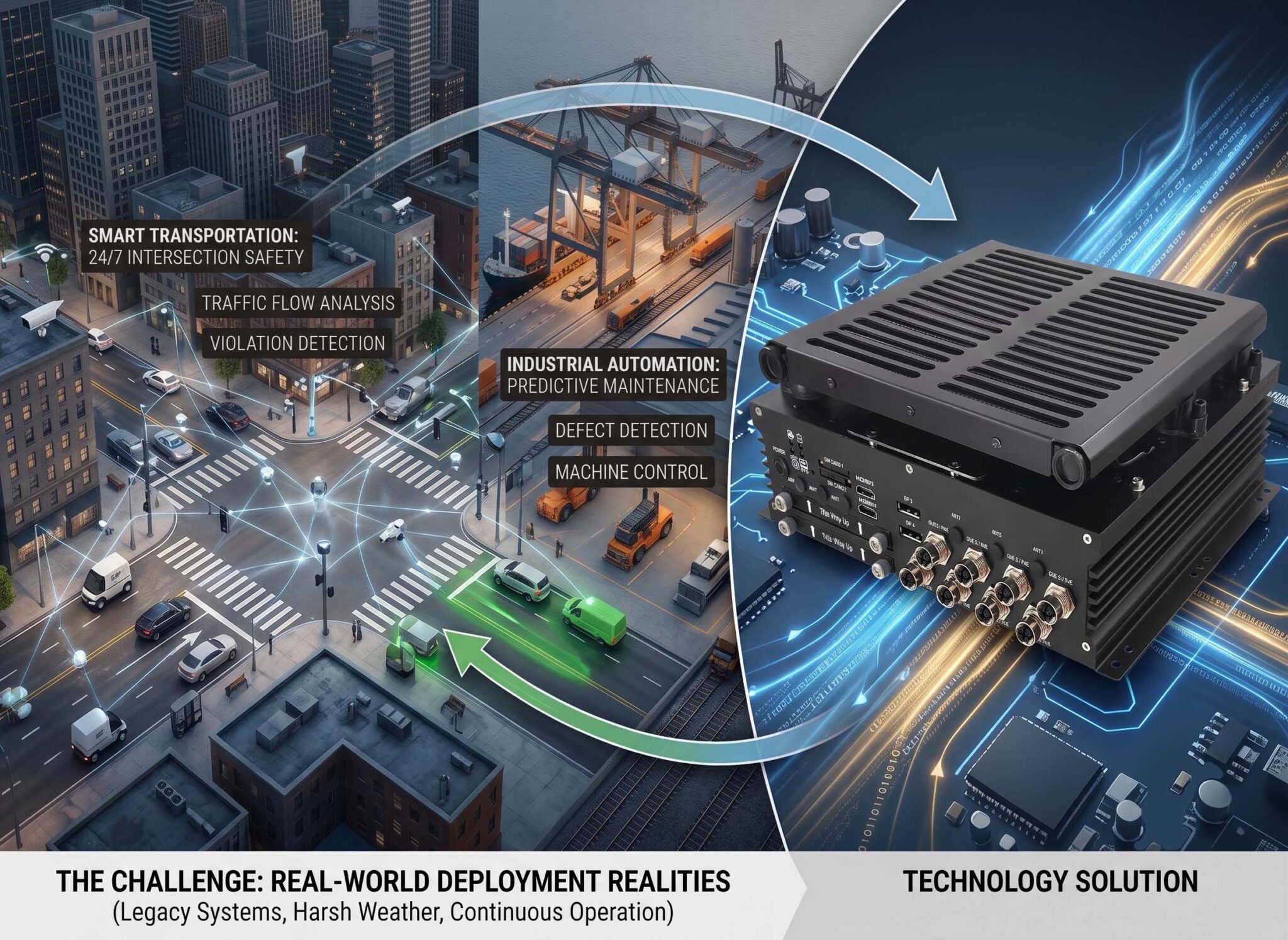
In urban scenarios, Edge AI challenges are often framed as issues of compute or environmental constraints. However, from a hardware and deployment perspective, the most underestimated factor is system uncertainty introduced by integration. In real-world environments such as smart cities and industrial operations, AI does not operate in isolation. It must coexist with legacy systems, unpredictable conditions, and continuous operational demands. Consider a traffic system that must function 24/7 without interruption, or a production line where downtime is not an option. The challenge is not just deploying AI, it is ensuring that AI integrates seamlessly into complex ecosystems and continues to operate reliably under changing conditions. This is where many AI initiatives struggle, not at the algorithm level, but at the system level.
Why AI Must Move to the Edge
These real-world constraints explain why many AI applications cannot rely solely on the cloud. First, real-time responsiveness is critical. In applications such as collision avoidance, anomaly detection, or automated control, decisions must be made within milliseconds. Any delay caused by sending data to the cloud and back can compromise both performance and safety. Second, connectivity is not guaranteed. Urban and industrial environments often face unstable or limited network conditions. Systems that rely entirely on cloud connectivity risk operational failure when networks are disrupted. Edge computing ensures continuity, even in offline or low-bandwidth scenarios.
Third, data volume is massive. Video and sensor data generate significant bandwidth demands. Transmitting all raw data to the cloud is both costly and inefficient. Processing data at the edge allows for real-time filtering, sending only actionable insights upstream. Finally, security and data sovereignty matter. In applications such as smart infrastructure or defense, sensitive data cannot always leave the local environment. Edge computing helps mitigate exposure risks while supporting regulatory compliance. In short, Edge AI is not just an architectural choice. It is a necessity driven by the realities of deployment.
Where Edge AI Hardware Delivers the Most Value
From our experience, the most impactful Edge AI deployments share three defining characteristics: they require real-time decision-making, operate in harsh environments, and involve complex system integration. This is why we focus on three key application domains:
Smart Transportation
From traffic flow analysis to violation detection and intersection safety, these systems demand millisecond-level decisions and continuous outdoor operation. They must withstand extreme temperatures, weather conditions, and integrate tightly with traffic infrastructure. Even minor delays can have immediate consequences.
Industrial Automation
In manufacturing environments, AI enables defect detection, predictive maintenance, machine control, and increasingly, Physical AI in industrial robotics, where machines must perceive, interpret, and respond to real-world conditions in real time. These systems must operate 24/7 with minimal downtime, making reliability and stability non-negotiable.
Defense and Mission-Critical Applications
In unmanned systems, surveillance, and tactical operations, AI must function in disconnected or degraded network environments. Hardware must endure vibration, temperature extremes, and power instability. In these scenarios, Edge AI is not about optimization—it is about ensuring mission continuity.
The Real Differentiation: Reliability at the Edge
Across all these scenarios, one principle remains constant: AI must make decisions on-site, in real time, and without failure. This fundamentally changes the role of hardware. Edge AI platforms must go beyond performance metrics to address real-world challenges through:
Robust thermal design, enabling stable operation across extreme temperatures
Resilient power architecture, ensuring continuity during fluctuations or outages
High-bandwidth connectivity, supporting real-time data processing
Modular system design, allowing flexible integration and scalability
At SINTRONES, our role is not simply to provide computing platforms. It is to ensure that AI systems can operate reliably in the environments where they matter most. We work closely with system integrators and end users to reduce integration risks, maintain system stability, and accelerate the transition from deployment to real-world impact.
From AI Capability to Real-World Value
As AI continues to evolve, the conversation must shift. The question is no longer: Who has the most powerful AI? The real question is: Who can ensure AI delivers value consistently, reliably, and in the real world? Because in the end, AI is only as powerful as its ability to perform where it matters most.