

Efficient Edge AI for Fleet and Rail: SINTRONES VBOX-3631 with Intel Wildcat Lake
Efficient edge AI built for low latency onboard inference, rugged connectivity, and reduced dependence on continuous cloud access
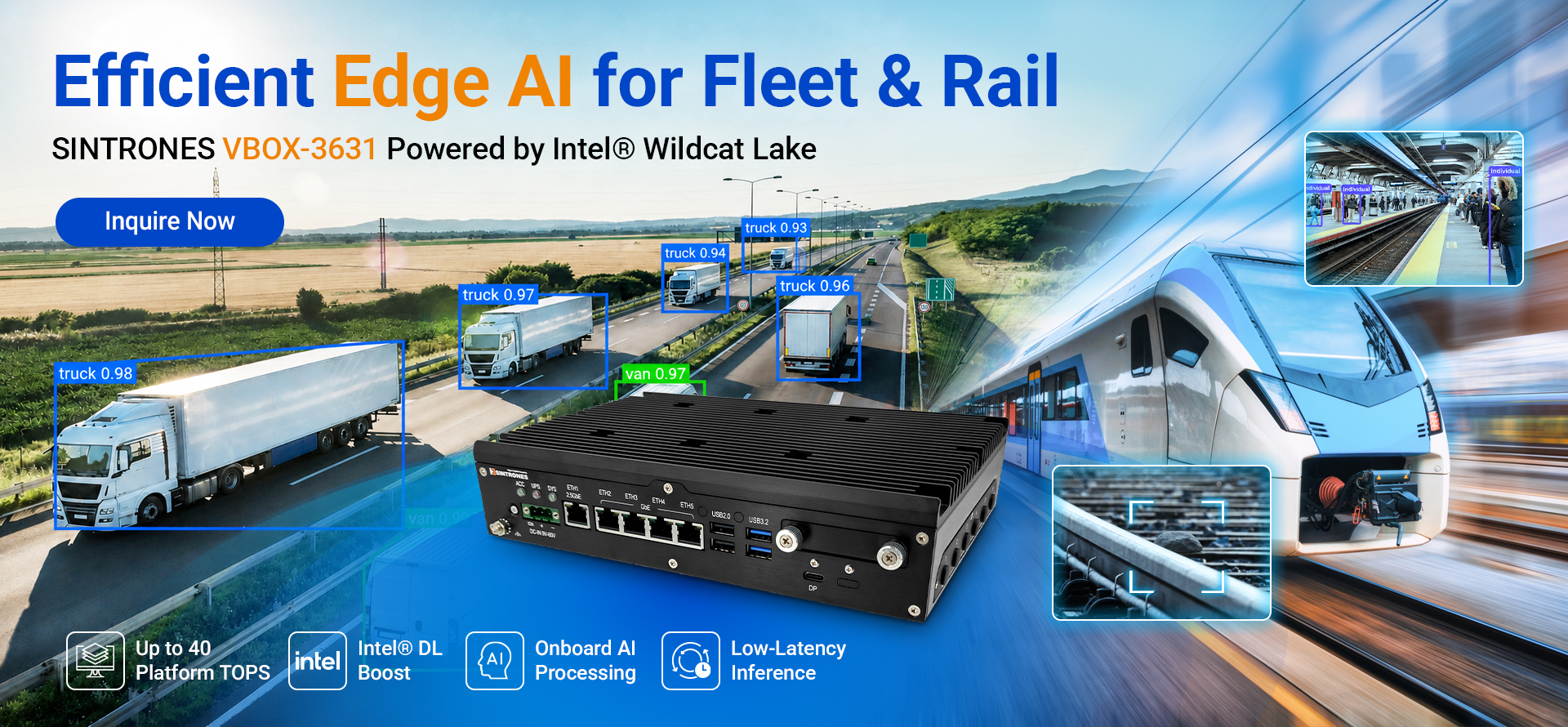
As artificial intelligence rapidly reshapes transportation operations, system integrators face a practical challenge: how to deploy real-time, efficient onboard AI computers for vehicles and rolling stock without making every decision dependent on cloud connectivity.
While cloud-based AI offers centralized computing and management, continuous data transmission can introduce variable latency, bandwidth costs, and data-governance considerations. For fleet and railway applications, local edge AI inference systems offers a practical way to process selected workloads close to their data sources, reducing data transmission latency as well as enhancing data privacy and security through offline AI inference. However, the challenge is to balance model requirements, available computing resources, and vehicle power constraints.
What is the SINTRONES VBOX 3631 Efficient Edge AI Computer?
The SINTRONES VBOX-3631 is a fanless, rugged in-vehicle embedded system designed to run AI inference workloads locally in fleet and rolling stock environments. Powered by the Intel® Core™ Series 3 processors (Wildcat Lake), it integrates CPU, GPU, and NPU acceleration to support real-time video analytics, event detection, and sensor-data processing. Furthermore, with Intel® OpenVINO™, system integrators can optimize and deploy compatible AI models directly onboard vehicles, reducing cloud dependency, network latency, and data transmission costs.
How Does Intel Wildcat Lake Deliver Up to 40 Platform TOPS?
The VBOX-3631 offers three processor options—Intel® Core™ 7 350, Core™ 5 320, and Core™ 3 304—allowing integrators to balance AI performance, power efficiency, and application requirements. The Intel® Core™ 7 350 configuration provides up to 21 GPU TOPS and 17 NPU TOPS, delivering up to 40 Platform TOPS of combined peak AI computing performance across the CPU, integrated GPU, and NPU. Integrated with the Intel Wildcat Lake processors, the vehicle AI computer enables efficient local AI inference, supporting AI workloads such as intelligent video analytics, object detection, and sensor-data processing.
The VBOX-3631 combines complementary AI processing engines and Intel® OpenVINO™ to support efficient local inference:
| Compute engine | Key Capability | Edge AI Applications |
| CPU (Intel® DL Boost) | 2 Performance cores + 4 Low-Power Efficient cores | Vehicle communications, application logic, and data preprocessing |
| Integrated GPU (iGPU) | Up to 21 peak INT8 TOPS | Parallel AI inference and video processing |
| Dedicated NPU | Up to 17 peak INT8 TOPS |
Power-efficient onboard AI inference |
| Intel® OpenVINO™ Toolkit | Model optimization and deployment across supported compute engines |
Accelerates compatible AI models across CPU, GPU, and NPU |
For fleet and railway deployments, the VBOX-3631 offers 1 × 2.5GbE and up to 4 × GbE ports, two CAN FD interfaces, and optional locking M12 connectivity. These interfaces help integrate cameras, vehicle networks, and peripheral devices within one onboard platform. Applications can also be configured to send selected events or summaries to central services instead of continuously transmitting all raw data.
Rugged Design and Power Management for Fleet & Rail
Reliable vehicle deployments require mechanical resilience, stable power, and hardware that can be maintained in the field. The VBOX-3631 addresses these needs with the following design features:
- Engineered for Automotive and Railway Environments
The SINTRONES VBOX-3631 is engineered for demanding automotive and railway applications, combining fanless operation, wide-temperature support, and vibration-resistant construction for reliable onboard computing. Its published specifications list E-Mark and EN 45545-2 (R25); the platform is also designed with EN 50155 railway requirements in mind. System integrators can request the latest compliance documentation and configuration guidance for their projects. - Ruggedized Connectivity
- The chassis is designed and tested in accordance with specified MIL-STD-810H shock and vibration methods. Optional M12 X-coded Ethernet connectors provide secure, locking connections for high-vibration installations. To ensure reliable operation, select the appropriate power and I/O connector configuration based on specific vehicle design requirements.
- Wide Operating Range and Smart Power Management
A fanless thermal design supports an operating range of -40°C to +70°C under the published 0.6 m/s airflow condition; the permitted range depends on installed accessories. The wide 9–60V DC power input, ignition detection, and smart power management help accommodate common 12V, 24V, and 48V vehicle power systems. - Power-Loss Protection
An optional patented backup battery unit can provide up to five minutes of emergency power, depending on system consumption, to help support a controlled shutdown during unexpected power loss. With the battery kit installed, the published system operating temperature is limited to -10°C to +50°C. - Simplified Maintenance
A front-accessible, removable RTC battery tray lets field engineers replace the coin-cell battery without dismantling the computer. Combined with the fanless design and accessible expansion cover, this can reduce routine service effort and support a lower maintenance burden over the system lifecycle.
Where Can the VBOX 3631 Support Edge AI in Smart Mobility
The fanless industrial PC VBOX-3631 can be evaluated as an onboard computing foundation for several mobility and industrial scenarios. Specific models and software stacks should be validated for the required frame rate, latency, environmental conditions, and functional safety needs.
- Fleet and Public Transportation
Supports integration of driver monitoring, event detection, vehicle telemetry, predictive maintenance analytics, and fleet logistics systems for commercial vehicles and public transit. Safety-critical ADAS functions require separate system-level validation. - Railway and Rolling Stock Computing
Can support onboard passenger information, video analytics, equipment-condition monitoring, and selected vision-based assistance workloads. Pantograph or track monitoring and safety-related obstacle detection require application-specific sensors, models, testing, and regulatory assessment. - Autonomous Logistics (AMR / AGV)
Provides local compute and connectivity that developers can evaluate for sensor fusion, robot telemetry, and compatible perception or navigation tasks in warehouses and factories. Suitability for SLAM and collision avoidance depends on software, sensor configuration, and validation results. - Smart City and Traffic Analytics
Can serve as a local analytics node for applications such as license plate recognition, traffic observation, and object detection using compatible vision models. Camera count and inference throughput should be benchmarked using the intended resolution, model, and processing engine.
With Intel® Core™ Series 3 (Wildcat Lake) processing, integrated AI acceleration, and rugged vehicle-ready design, the SINTRONES VBOX-3631 offers a cost-effective platform for deploying local AI inference across fleet, railway, and intelligent transportation applications. For detailed specifications and project inquiries, visit the efficient edge AI computer VBOX-3631 product page.