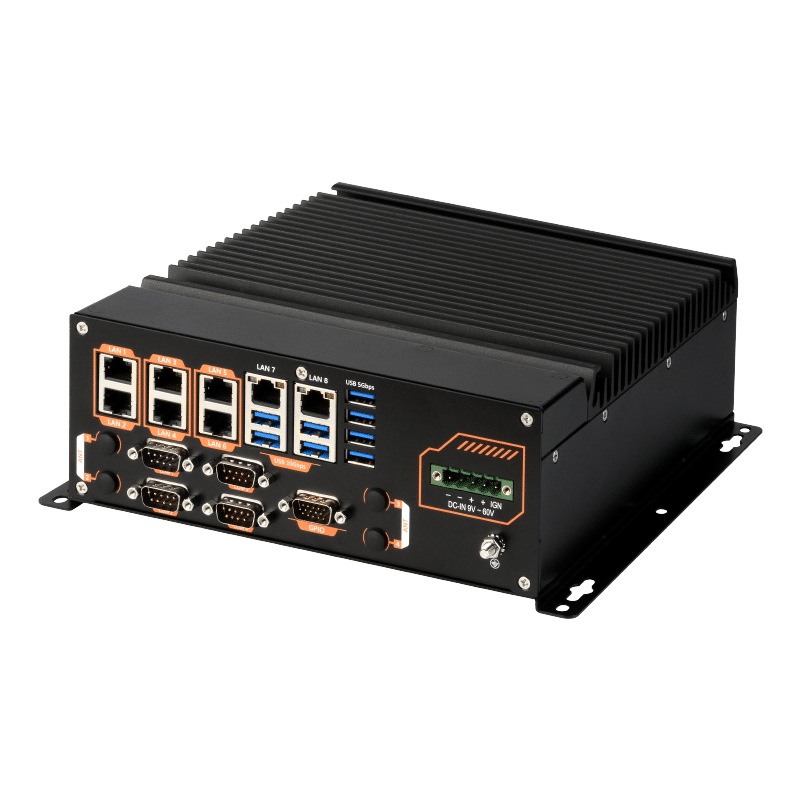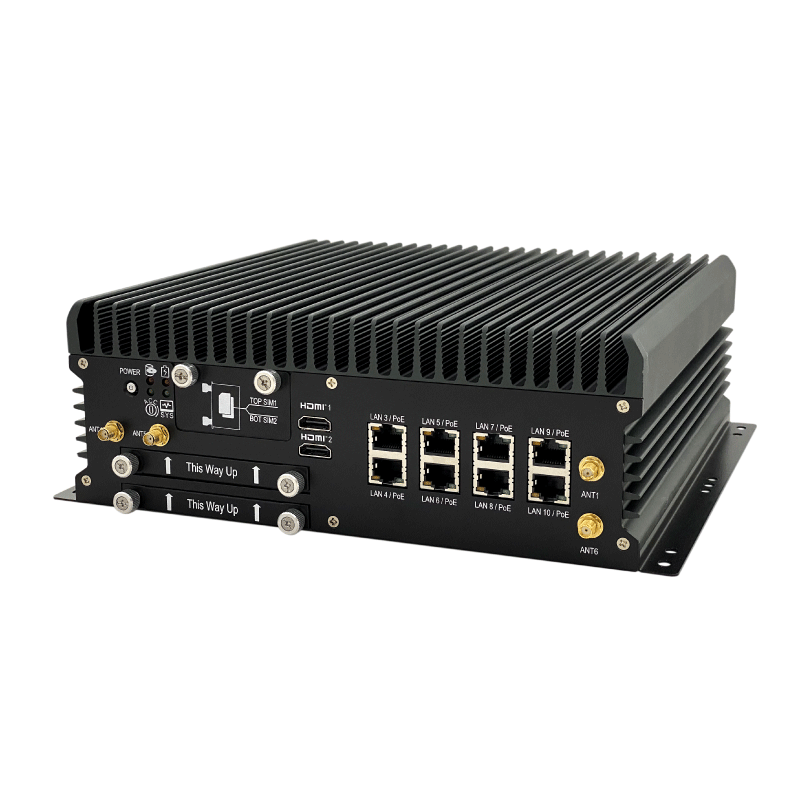
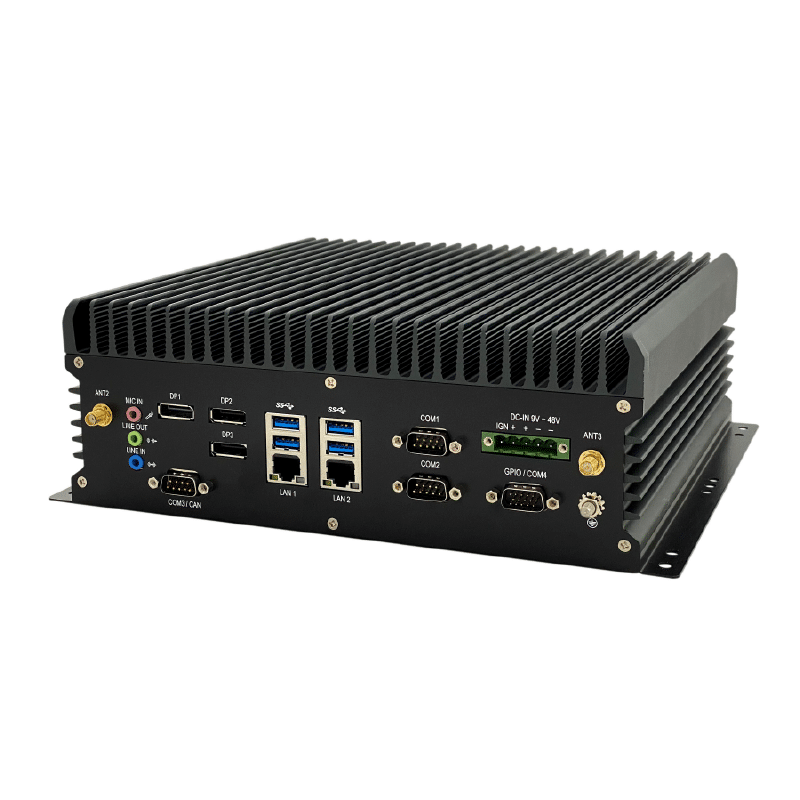



• Intel Gen10 Xeon W-1290TE (20M Cache 1.8GHz up to 4.6GHz)*
*Use only with Intel W480E
• Intel Gen10 Core i9-10900TE (20M Cache 2.0GHz up to 4.5GHz)
• Intel Gen10 Core i7-10700TE (16M Cache 2.0GHz up to 4.4GHz)
• Intel Gen10 Core i5-10500TE (12M Cache 2.3GHz up to 3.7GHz)
• Intel Gen10 Core i3-10100TE (6M Cache 2.3GHz up to 3.6GHz)
• Intel Gen10 Core G5900TE (4M Cache 3.0GHz)
• Q470E / W480E
• 2 x DDR4 2666/2933 MHz SO-DIMM up to 64GB (Optional ECC support with Xeon W-1290TE)
• 9 x Intel i210-AT and 1 x i219LM (iAMT9.5 w/ i5, i7 only) Gb/s Ethernet Controllers Onboard Support PXE and WOL
• 2 ~ 255 Level Reset
• 2.0
• 3 x RS 232/422/485 (option additional 1 x RS 232/422/485)
• 4 x USB 3.2 5Gbps Ports
• 10 x RJ45 Ports for GbE (Optional 8 with M12 X Coded Connectors and 8 x PoE Total Max.120W)
• 3 x DP (Intel built-in GPU), 2 x HDMI Ports (MXM Graphics)
• 8 x DI (5~48VDC) and 4 x DO (5VDC, 100mA)
• 1 x Line-out, 1 x Line-in and 1 x Mic-in
• 1x M.2 A-E Key 2230 slot, 1 x M.2 B Key 3042 Slot w/ 2 x SIM Card Sockets for WWAN
Patent No. : M592609 – Automatic SIM Card Detection
• 2 x Full Mini-PCle Slots and 1 x Full Mini-PCIe Slot w/ USB interface only for WWAN sharing 2 x SIM Card Sockets with M.2 B Key 3042 Slot
• Windows 10 64bit, Ubuntu 20.04 64bit
• 2 x 2.5” Drive Bay for SATA Type HDD/SSD RAID 0, 1, 5
• 1 x M.2 M key 2280 slot supports NVMe and SATA SSD
*Thermal heatsink is required for M.2 storage. Please contact sales representative for more information.
• Intel® UHD Graphics 630 for z9/i9/i7/i5/i3, Intel® UHD Graphics 610 for G5900TE
• NVIDIA® Quadro® RTX A4500 Mobile GPU
• NVIDIA® Quadro® RTX A2000 Mobile GPU
• NVIDIA® Quadro® RTX 3000 Mobile GPU
• NVIDIA® Quadro® T1000 Mobile GPU
• Max Resolution: 1920 x 1080 @ 60Hz without HDMI Audio
• -40ºC ~ 70ºC w/0.6 m/s airflow (for barebone system)
*The operating temp. varies by accessories installed.
Patent No. : M565941 – Thermal Cooling
• -40°C ~ 80°C
• 10% RH – 90% RH (non-condensing)
• IEC60068-2-64, random, 2.5G@5~500Hz, 1hr/axis
• MIL-STD-810G, Method 514.6, Procedure I, Cat.4, Operating
• Operating: MIL-STD-810G, Method 516.6, Procedure I, Trucks and semi-trailers=15G (11ms) with SSD
• CE, FCC Class A, E13, ECE R118, EN50155, EN45545-2 R25
• 9V – 48V DC Power Input
• Automatics Recovery Short Circuit Protection
• Vehicle Power Ignition for Variety Vehicle
• Power off Delay Time Setting by BIOS and Software
• Internal Battery Kit for 10 Mins Operating
(Charging Temp. 0~45ºC, Discharging Temp. -10~60ºC)
*UPS backup time varies depending on actual overall system power consumption and battery is required to be charged before using.
Patent No. : M447854 – Build-in Battery
• Aluminum Alloy
• Wall-mount
• 5300g (Barebone)
• 260(L) x 250(W) x 95(H) mm
ABOX-5210xyy-zz (x= P= w/PoE, x= Empty= w/o PoE, yy=G6=RTX 3000, yy=G7=T1000, zz=Z9= W-1290TE, zz= i9= i9-10900TE, zz= i7= i7-10700TE, zz= i5= i5-10500TE, zz= i3= i3-10100TE, zz= C1= G5900TE)
Intel 10th Gen 10 Cores Xeon, i9 CPU w/ NVIDIA® Quadro® GPU Option/ 10 x GbE (Optional 8 x PoE)/ 3 x COM/ 3 x DP/ 2 x HDMI/ 4 x USB 3.2 Gen 5Gbps/ 9-48V Input AI GPU Computing
Made in Taiwan
DDR4 SO-DIMM, 4GB~32GB, -40~85°C
M.2 2280 Key B-M NVMe TLC -40~85°C 64GB~2TB w/ Heatsink
M.2 2280 Key B-M SATA TLC -40~85°C 64GB~2TB w/ Heatsink
2.5 inch SATA TLC -40~85°C 64GB~2TB
M.2 2230 Key A-E 802.11 a/b/g/n/ac, Wi-Fi 6E
M.2 3042 Key B 5G & LTE Module
MiniPCIe GPS Module
MiniPCIe CANBUS Module
BAT-5200 Battery Kit, 5200m/h, -30~60ºC, Discharge -20~60ºC, Operating About 10 Mins
AC/DC 24V Power Adapter
| Model | ABOX-5210G6 | ABOX-5210G7 | ABOX-5210G8 | ABOX-5210G9 |
|---|---|---|---|---|
| MXM Graphics | NVIDIA® Quadro® RTX 3000 | NVIDIA® Quadro® T1000 | NVIDIA® Quadro® RTX A4500 | NVIDIA® Quadro® RTX A2000 |
| Graphic Memory | 6GB GDDR6 | 4GB GDDR6 | 16GB GDDR6 | 8GB GDDR6 |
| CUDA Cores | 1920 | 896 | 5888 | 2560 |
| Tensor Cores | 240 | N/A | 184 | 80 |
| RT Cores | 30 | N/A | 46 | 20 |
| System Operating Temp. | 0ºC ~ 60ºC w/0.6 m/s airflow | 0ºC ~ 70ºC w/0.6 m/s airflow | 0ºC ~ 60ºC w/0.6 m/s airflow | 0ºC ~ 70ºC w/0.6 m/s airflow |
一項重大的智慧城市計畫正致力於將路面電車網絡現代化,以因應開放道路環境中日益增長的安全需求。為了守護乘客的安全,交通主管機關需要一套先進的「路面電車防碰撞系統」。該專案的目標是打造一個前瞻性的安全骨幹,能針對繁忙都市中的路面電車進行即時障礙物辨識(Real-time tram obstacle detection)。 搞定複雜路況,軌道交通的超低延遲技術 路面電車在與汽機車、行人共享路權的開放道路上行駛,面臨著獨特的技術挑戰。與封閉式軌道不同,電車必須穿梭於障礙物隨時可能竄出的「都市叢林(Urban Canyons)」中。為了提供煞車系統或駕駛足夠的反應...
Read more
2025.6.19 邊緣 AI 運算供應商 SINTRONES 鑫創電子(股票代碼:6680)宣佈與其長期合作夥伴 Akermann Electronic Praha 於中歐最具影響力的國防安全展會 IDET 2025 中,展出一系列邊緣 AI 軍事解決方案(Rugged Edge AI Defense Solutions),作為其軍事防禦的核心。Akermann 為捷克知名的商務技術與專案導向應用方案商,深耕國防與安全領域多年。 本次展出的頂尖軍事運算方案包括:搭載 NVIDIA® Jetson AGX Orin™ 與 Orin™ NX 模組的 IBO...
Read more
SINTRONES, a global leader in computing technology for in-vehicle applications, officially announces the launch of its new ABOX-5210G Series integrated with the NVIDIA® Quadro® RTX 3000 GPU. This next-generation edge ai computer series exhibits a superior range of fanless systems...
Read more
SINTRONES introduces its next-generation Edge AI Computing solutions, engineered to deliver rugged, high-performance processing directly at the network edge. Powered by 10th-Gen Intel® Core™/Xeon® processors and NVIDIA® GeForce GPU, our fanless systems unlock unparalleled computi...
Read more
Problem How to prevent or minimize the virus transmission that causes COVID-19 in public transit. Solution Implementing SINTRONES ABOX-5210G allows drivers and passengers to avoid the risk of cross-infection. Through the PoE function proved by ABOX-5210G, connecting IP cam...
Read more
SINTRONES, one of the global leaders in computing technology in vehicles, announces the launch of the new ABOX-5210G. The new ABOX-5210G Fanless Computer are powered by AI GPU computing, Intel Gen 10 Core i9, with NVIDIA GPU technology. The new series incorporates numerous unique...
Read more